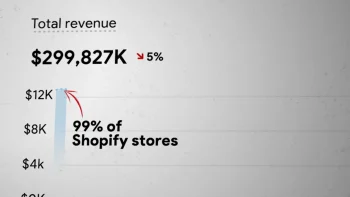
There’s a trick I’m using with Shopify SEO clients to stay visible as Google floods search results with AI. That matters because 16% of ecommerce queries now show AI answers. They’re quietly stealing your traffic and sales. Most store owners have no idea it’s even happening.
This is the most dense, free Google Ads optimization training to get more profit for your ecommerce brand. I’ve condensed 20 years of Google Ads experience, and what we do at our Shopify marketing agency every day to scale Shopify stores, into 54 rapid tips you can apply right now to get more profit.
You can improve your Google Ads performance with these simple optimizations even if you’re a beginner or have been doing it for 10 years. These simple methods have generated real profit for hundreds of brands. I’ve even created a helpful checklist for you to download and keep at the end.
I tried to get four different pages of a Shopify store to rank for featured snippets, using a beginner SEO technique anyone can use. With a tight timeframe of 7 minutes per page to get number one in Google, this method is fast and effective.
Adding to the excitement, for every page that doesn’t rank for a featured snippet in the top spot, $1000 will be given to a random YouTube subscriber.
Read on to see how you can apply the SEO strategy to your Shopify store so you too can quickly increase sales from organic search.
If you did nothing else in the next 30 days to launch your next product, or improve a current product, other than follow the product creation secrets that I’m about to show you, you’d grow your online store’s sales faster than 90% of all businesses.
In this video below, I’ll give you tons of product creation examples from real e-commerce brands, breaking down winners. You’ll learn what’s important for winning sales in e-commerce with a simple formula so that you can do it too.
Whether you sell private label, do dropshipping, or develop your products from scratch, this is how you smash competitors, even Amazon. I will also give you an insider trick of someone doing this as I travel to Turkey to spy on a multi-million dollar Shopify client who makes winning products within 2 days.
Discover how ancient garden design principles can help you sell and retain more Shopify subscriptions. Whether you’re thinking about setting up a subscription or already have one, I’ll show you the tactics used by million dollar and one hundred million dollar brands.
I’ve read a few books and currently care for my own new Japanese garden built from scratch and am amazed at the principles that help Digital Darts’ clients grow their business. Japanese gardens are not merely picturesque landscapes; they are meticulously crafted with each element serving a purpose.
This blog post, inspired by our YouTube video below, reveals nine secrets to supercharge your Shopify store with predictable revenue every week, month, and year.
Allbirds and Gymshark are on Shopify and they can’t get their hreflang tags right. The public companies failed, even with their resources, because there’s no native way to manage tags for multiple Shopify accounts. Shopify’s own documentation in 2021 told you the basics of hreflang tags on a homepage, but you were left bewildered with how to do it sitewide.
As a result of working with clients who had this exact struggle, the Digital Darts team and I invented three ways to get perfect hreflang tags in Shopify. You’ll learn how to correct every type of error, every variable you must consider, and how to keep your tags fresh with minimal effort. Businesses on WordPress, Magento, and other platforms can use what’s shared with minor alterations. No one has taught it in-depth until now. In this guide, you’ll get it all to delight Google.
This is an advanced guide on how to profitably scale your Shopify store for Facebook and Instagram ads. It presumes familiarity with Facebook Business Manager, and that you have recently managed profitable campaigns. In other words, you will get the most of it if your Shopify business is already profitable on the ad channel and you want to scale your Facebook and Instagram Ads.
The strategy details the methods we used to take one Shopify brand from $300/month to $300,000/month. The outlaid strategies and tactics help us regularly grow accounts to unseen levels.
If you want a simple, quick-read guide to grow your business, go elsewhere. This guide gets technical. It dives deep into the nuts and bolts of exactly what it takes to go from spending tiny amounts to thousands per day, whilst hitting revenue goals.
The most comprehensive tutorial ever written about Google Shopping. Since it’s first publication in 2019, I’ve kept it updated with features like Performance Max to be relevant today.
Google Shopping offers the ultimate way to level up revenue for many Shopify stores. We have managed approximately one hundred Google Ads accounts for various stores, and it’s common for my team and I to produce a return on investment for our clients of 300-2000%. While these results are not possible for all businesses, the Google Shopping channel is a golden source of customers wanting products. This is a step-by-step guide to show you how to get started then grow any shopping campaign.
Whether I’m picking up a new novel or buying a new monitor stand, I’m hitting up the reviews first. And if the product is new to me, I’m going to do a little recon.
I’m not alone in this. 54.7% of people read at least 4 products reviews before purchasing, yet 1-in-5 shoppers say they fully trust the reviews on a brand’s own website. We all know reviews matter, but where those reviews are seen matter more.
To help collect reviews in a way that builds trust, Google has Shopify merchants covered with a nifty, free program: Google Customer Reviews. The program aims to create trust for users in their shopping experience through third-party reviews.
To set up the program in Shopify, all you have to do is follow this tutorial.
A campaign at 6x return can still lose you money. My free Profit Leak Scan is an AI skill you run in ChatGPT, Claude or Gemini on your own Google Ads and Shopify data. It shows which of your campaigns lose money, what you're spending on people already searching your name, and the three fixes worth doing this week. Enter your name and email and I'll send it:
We use cookies to ensure you get the best experience on our website. Consenting to these technologies allows us to process data such as browsing behaviour or unique IDs on this site. Not consenting affects certain features and functions.
Functional
Always active
The technical storage or access is strictly necessary for the legitimate purpose of enabling the use of a specific service explicitly requested by the subscriber or user, or for the sole purpose of carrying out the transmission of a communication over an electronic communications network.
Preferences
The technical storage or access is necessary for the legitimate purpose of storing preferences that are not requested by the subscriber or user.
Statistics
The technical storage or access that is used exclusively for statistical purposes.The technical storage or access that is used exclusively for anonymous statistical purposes. Without a subpoena, voluntary compliance on the part of your Internet Service Provider, or additional records from a third party, information stored or retrieved for this purpose alone cannot usually be used to identify you.
Marketing
The technical storage or access is required to create user profiles to send advertising, or to track the user on a website or across several websites for similar marketing purposes.
We use cookies to ensure you get the best experience on our website. Consenting to these technologies allows us to process data such as browsing behaviour or unique IDs on this site. Not consenting affects certain features and functions.
Functional
Always active
The technical storage or access is strictly necessary for the legitimate purpose of enabling the use of a specific service explicitly requested by the subscriber or user, or for the sole purpose of carrying out the transmission of a communication over an electronic communications network.
Preferences
The technical storage or access is necessary for the legitimate purpose of storing preferences that are not requested by the subscriber or user.
Statistics
The technical storage or access that is used exclusively for statistical purposes.The technical storage or access that is used exclusively for anonymous statistical purposes. Without a subpoena, voluntary compliance on the part of your Internet Service Provider, or additional records from a third party, information stored or retrieved for this purpose alone cannot usually be used to identify you.
Marketing
The technical storage or access is required to create user profiles to send advertising, or to track the user on a website or across several websites for similar marketing purposes.